When Cheap Insurance Becomes Expensive During a Claim
A low insurance premium feels good on the day the policy is bought. It is easy to measure, easy to compare, and easy to explain. If two options both look like “home insurance” or “auto insurance,” the cheaper one can feel like the smarter decision.
The problem is that insurance is not truly tested when the premium is paid. It is tested when something breaks, burns, floods, injures someone, shuts down a business, or turns into a lawsuit. That is when the real cost of a cheap policy becomes clear.
At Derek Wiley Agency, the goal is not to make coverage unnecessarily expensive. The goal is to avoid the kind of savings that only looked good because nobody explained the tradeoff.
The point is not to avoid savings. The point is to avoid mistaking a lower number for a complete insurance risk strategy.
Cheap can be smart. Unexamined cheap is the danger.
There are legitimate ways to reduce insurance cost. A better carrier fit may lower premium. A higher deductible may make sense for someone with the cash reserves to absorb smaller losses. Discounts can help. Removing coverage that no longer applies can be reasonable.
Those are different from cutting premium by accident. That happens when a policy is copied from an old declaration page, quoted with default limits, stripped of endorsements, or built around a target price before anyone understands the real exposure.
The difference is advice. A lower premium is not automatically bad. But a lower premium should come with an explanation of what changed, what did not change, and what the client would still be responsible for after a claim.
The expensive part is often the uncovered part.
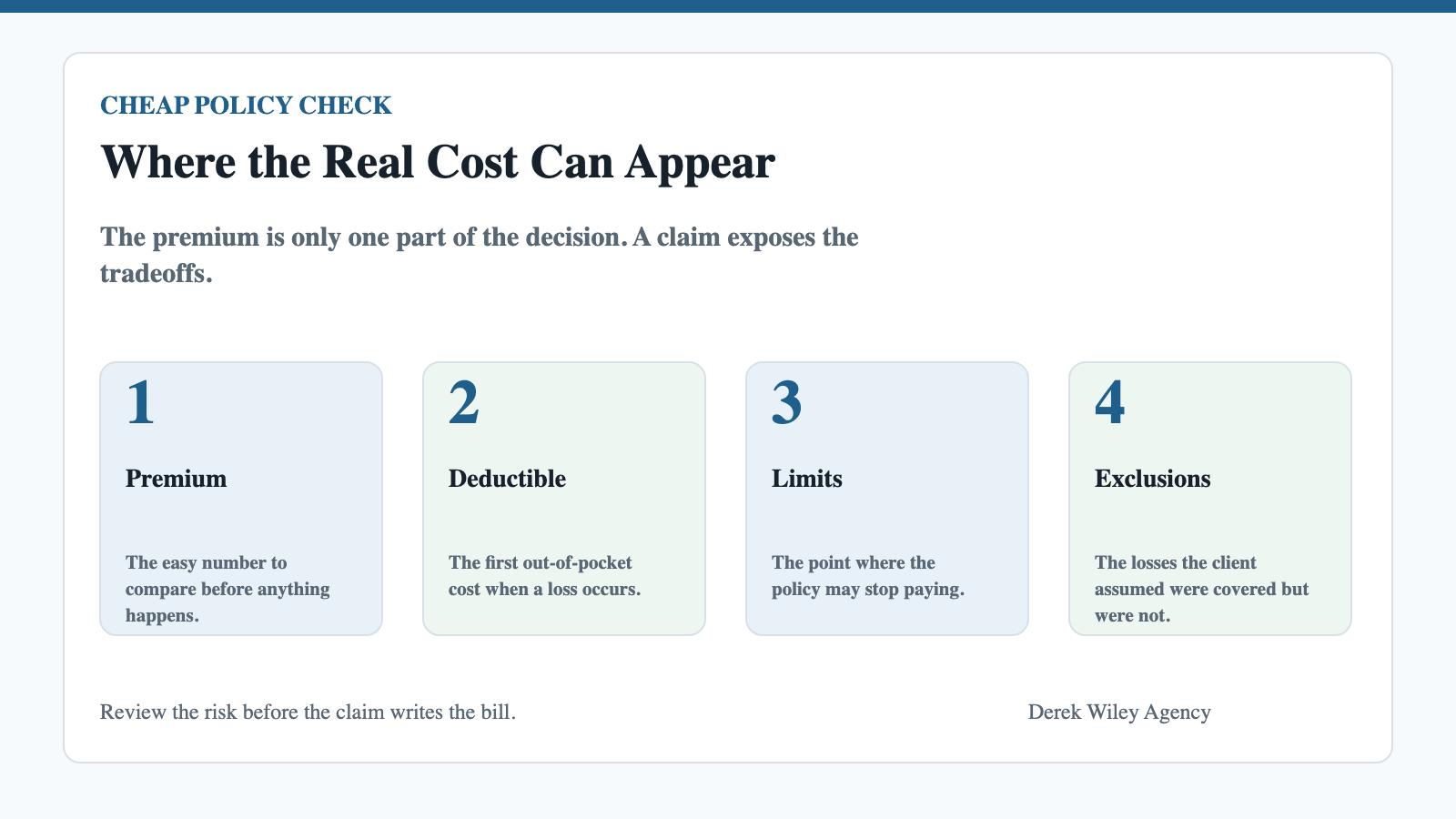
People usually think of insurance cost as the monthly or annual premium. During a claim, the expensive part may be the deductible, the uncovered water damage, the missing replacement-cost provision, the liability limit that runs out, the vehicle use that was not disclosed, or the business activity that was never matched to the policy.
A policy can be technically active and still fail to solve the problem a client thought it would solve. That is why “I have insurance” is not enough. The better question is: “What does this policy actually do when the specific thing I am worried about happens?”
Home insurance can look fine until the loss is specific.
Homeowners often assume the policy covers whatever happens to the home. In reality, the details matter. Water losses, sewer or sump pump backup, outside flood exposure, roof issues, replacement cost, ordinance requirements, detached structures, personal property limits, and loss-of-use needs can all depend on policy language.
A cheap homeowners policy may be cheaper because the carrier, deductible, valuation method, endorsements, or limits are different. That may be acceptable in some situations. It is not acceptable if the homeowner only finds out after the basement is damaged, the roof claim is disputed, or rebuilding costs more than expected.
For homeowners in Roanoke, Daleville, Botetourt County, and Southwest Virginia, storm, water, tree, liability, and reconstruction questions should be discussed before a loss. A quote alone does not prove those questions were asked.
Auto insurance can meet the rule and still miss the risk.
Auto insurance is another place where cheap can be misleading. A policy may satisfy the legal requirement and still leave a household exposed after a serious accident. Liability limits, uninsured and underinsured motorists coverage, medical payments, collision, comprehensive, rental reimbursement, drivers in the household, and umbrella coordination all matter.
The cheapest auto quote may be built around limits that do not fit the family, vehicles, income, home equity, savings, or young-driver exposure. If a serious injury claim exceeds the policy limits, the premium savings may not feel like savings anymore.
Business insurance gets expensive when the policy does not match the operation.
For a business owner, cheap insurance can be especially risky because the business may change faster than the policy. A contractor adds a crew. A service company starts using vehicles differently. A business signs a contract with insurance requirements. Equipment moves. Payroll changes. A side service becomes regular work.
If the policy is only quoted from a business name and a rough class code, important details can be missed. General liability, commercial auto, workers compensation, property, tools, professional liability, cyber exposure, subcontractors, certificates, and contract language may all need review.
The cost of a missed business exposure is not just the claim. It can be lost revenue, contract trouble, employee issues, customer disputes, or cash-flow strain.
A coverage review should explain the tradeoffs.
DWA’s Risk Advisory approach is built around the belief that clients should understand what they are buying. If a lower-cost option is appropriate, the client should know why. If a cheaper option creates a meaningful gap, the client should know that too.
A good review should answer questions like:
- What limits are protecting the household, business, or assets?
- Which deductibles apply, and can the client absorb them?
- Which losses are excluded or limited?
- Are there endorsements that should be considered?
- Does the policy reflect current home value, operations, drivers, vehicles, and assets?
- What would still come out of pocket after a realistic claim?
That conversation may not always produce the cheapest policy. It should produce a more informed decision.
If the savings came from weak liability limits, unresolved water exposure, or missing umbrella coordination, the next step may include a review of homeowners coverage gaps, auto limits beyond the legal minimum, and umbrella protection for larger claims.
What to do next.
If your current insurance was selected mainly because it was cheaper, it is worth reviewing what changed to create that price. The goal is not to overbuy. The goal is to avoid being surprised by a gap when the policy is finally tested.
A DWA coverage review can help you compare the premium to the real exposure across homeowners insurance, auto insurance, umbrella protection, and business insurance.
CTA: Request a Coverage Review
FAQs
Is cheap insurance always bad?
No. A lower premium can be appropriate when the coverage still fits the risk. The problem is choosing by price without understanding what changed or what may be missing.
Why can a cheap policy cost more during a claim?
A cheap policy can cost more if it carries low limits, high deductibles, missing endorsements, exclusions, or coverage assumptions that leave the client paying out of pocket after a loss.
What should I review before switching to a cheaper policy?
Review limits, deductibles, exclusions, replacement cost, liability exposure, endorsements, carrier fit, claim scenarios, and how the policy coordinates with other coverage.