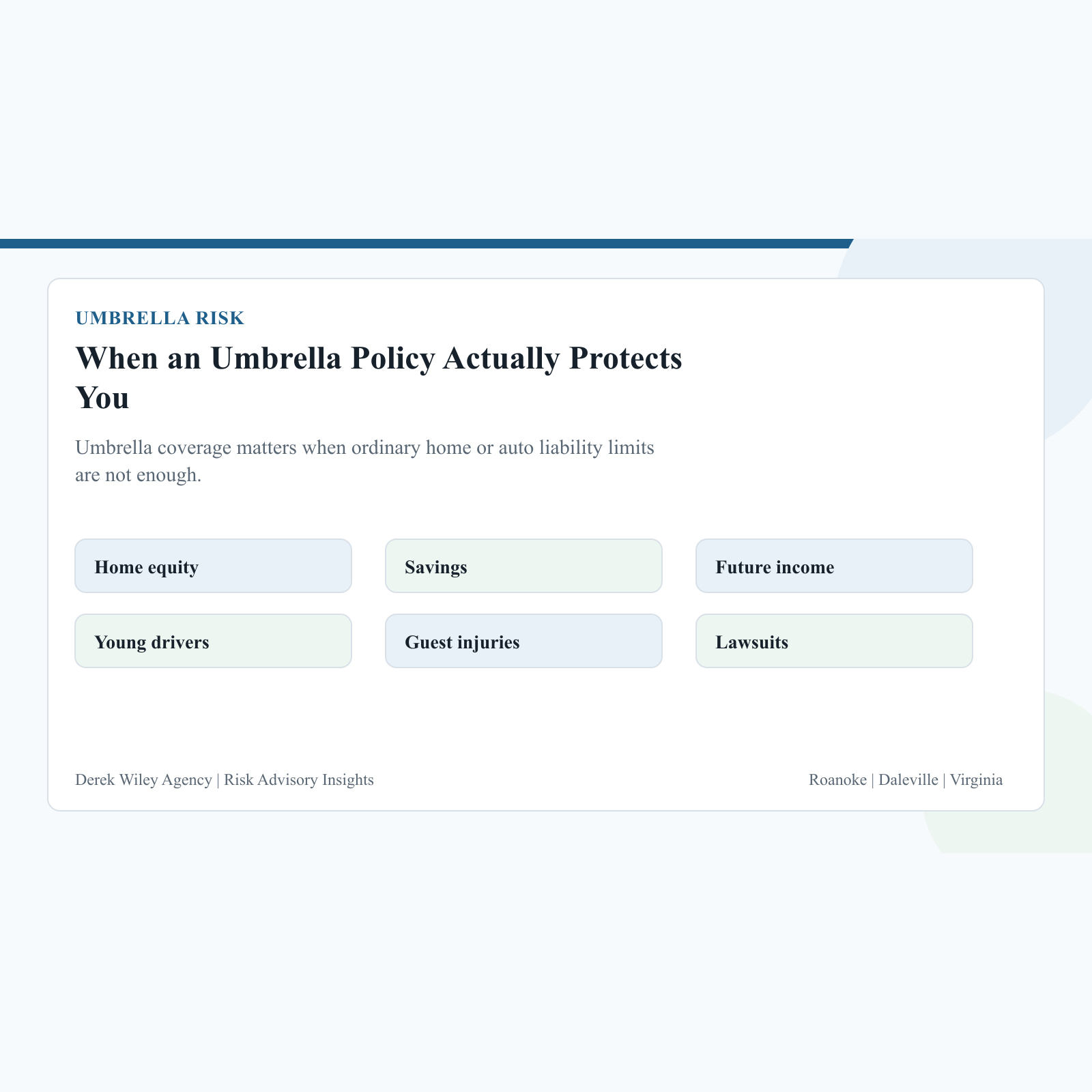
When an Umbrella Policy Becomes the Policy That Actually Protects You
Umbrella insurance is easy to ignore because most people do not expect to be sued.
That is exactly why it matters.
The claims that create umbrella conversations are often not part of a dramatic plan. They can start with a car accident, a guest injury, a dog incident, a fall at the home, a rental exposure, a young driver, or a situation that looked ordinary when it began. By the time the claim becomes serious, the question is no longer whether the policy was inexpensive. The question is whether the available liability coverage is enough.
At Derek Wiley Agency, umbrella insurance is not treated as a random add-on. It is reviewed as part of a broader Risk Advisory conversation: What assets are exposed, what liability limits are in place, and what would happen if a claim exceeded the ordinary policy limits?
Umbrella insurance sits above underlying liability coverage.
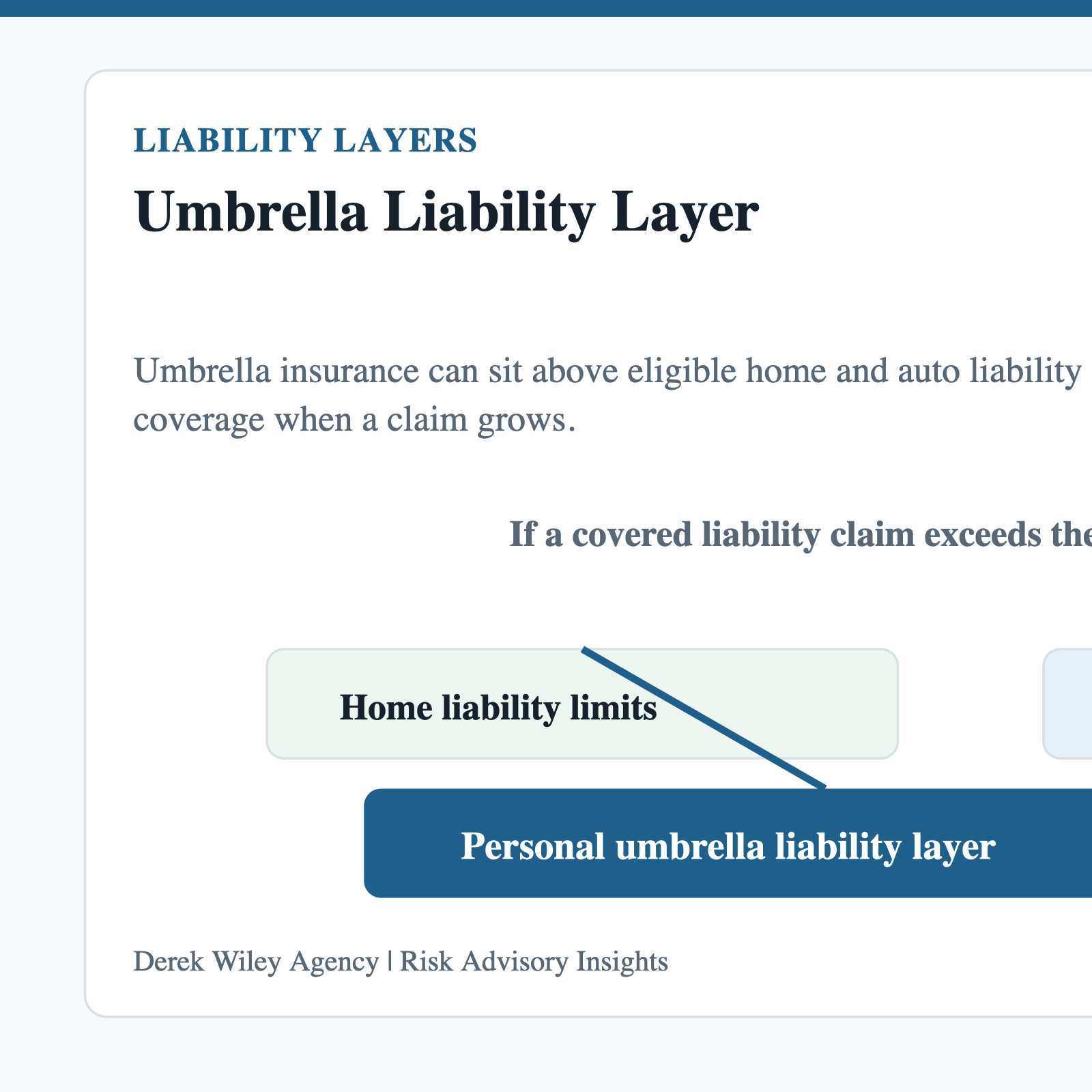
A personal umbrella policy can provide additional liability protection above eligible underlying policies such as auto, homeowners, boat, motorcycle, or other qualifying coverage. It is designed for larger liability claims that exceed the limits of the underlying policy, subject to policy terms, exclusions, and requirements.
That last part matters. Umbrella coverage is not a magic blanket over every possible problem. It typically requires certain underlying liability limits and has its own terms. That is why DWA reviews umbrella coverage in coordination with auto and homeowners policies, not separately.
The real question is not “am I wealthy?”
Many people assume umbrella insurance is only for wealthy families. That framing is too narrow.
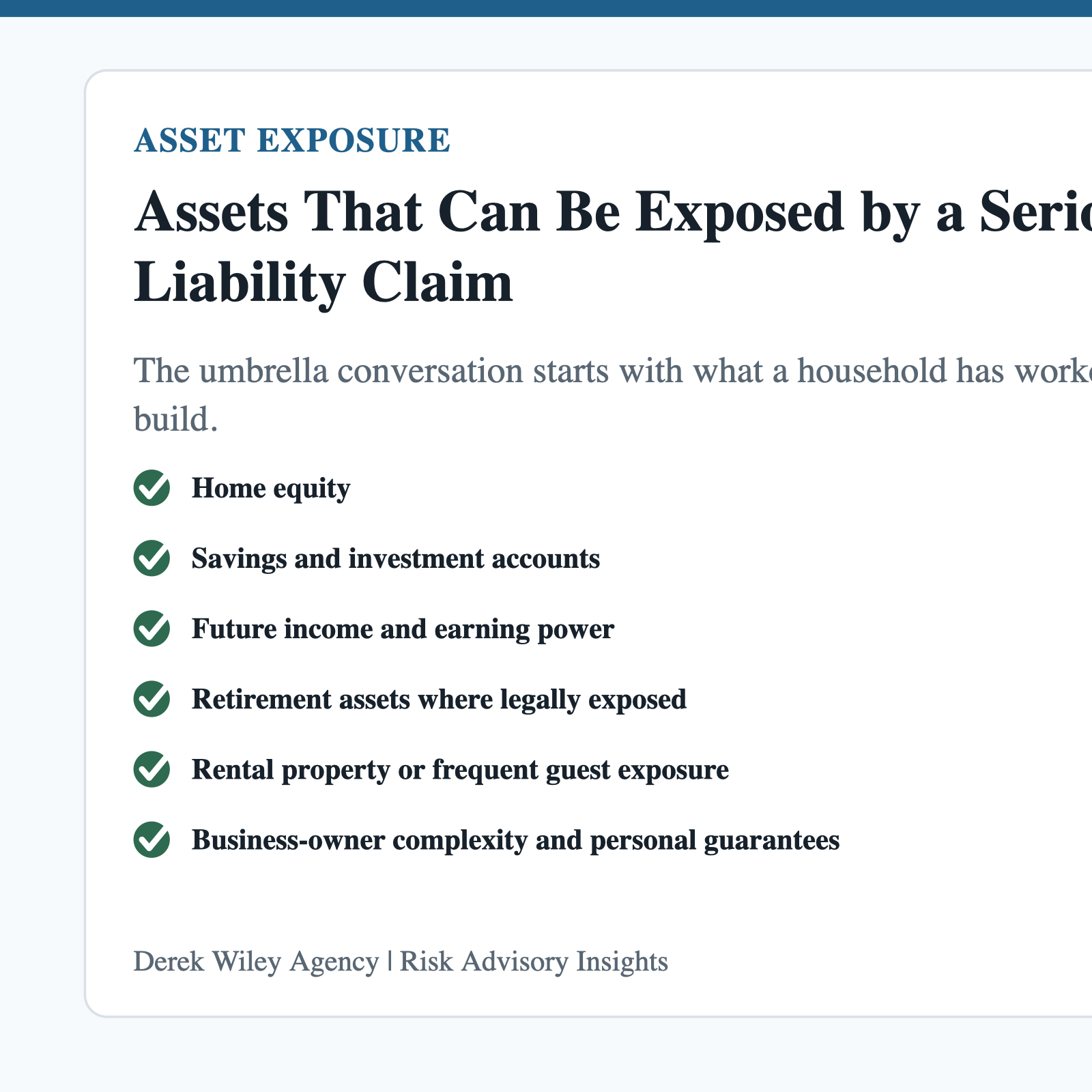
The better question is: “What could be exposed if a serious liability claim happened?”
That can include home equity, savings, retirement assets, income, future earnings, rental property, business-owner assets, and the financial stability a family has worked years to build. A household does not need to be ultra-wealthy to have something worth protecting.
For Virginia families in Roanoke, Daleville, Botetourt County, and surrounding communities, this often becomes relevant when there are young drivers, significant home equity, frequent guests, rental exposure, recreational vehicles, pets, or higher income.
Ordinary life can create liability exposure.
Derek’s examples are useful because they do not sound far-fetched. Someone slips on stairs leading to a deck. A guest is injured around a grill at a rental. A dog jumps on a visitor. A driver causes an accident that becomes more serious than the vehicle damage suggests. A favor for a friend creates an unexpected claim.
None of those situations require someone to be reckless or irresponsible. They are the kinds of things that happen in normal life.
That is why umbrella coverage is really a conversation about consequences. If the claim stays small, ordinary limits may be enough. If the claim grows, the household may be glad someone reviewed umbrella protection before the incident happened.
Umbrella planning often starts with the underlying policies. A serious auto loss depends on auto limits that are built for more than legal compliance, while a home liability claim depends on whether the homeowners policy was reviewed for real household exposure.
Auto accidents are one of the clearest umbrella triggers.
Auto liability can escalate quickly. Medical bills, lost wages, long-term injury claims, legal defense, and settlement demands can push beyond what a family expected when they selected an auto policy.
This is especially important for households with young drivers, multiple vehicles, long commutes, or meaningful assets. The car may be repaired quickly, but the liability claim may continue for months or years.
That is why DWA often connects auto insurance and umbrella insurance in the same review. A strong auto policy is the foundation. Umbrella coverage may be the additional layer that protects the household if the claim exceeds that foundation.
Homeowners liability can also exceed expectations.
Homeowners insurance includes liability coverage, but that does not mean the limit is always enough. Guests, pets, pools, stairs, rental situations, contractors, and household activities can all create exposure.
A homeowners policy should be reviewed for property protection and liability protection. The house itself matters, but so does what could happen to someone on or because of the property.
For homeowners with substantial equity, savings, income, or visitors, umbrella coverage can be one of the most important parts of the broader homeowners insurance review.
Business owners should pay attention too.
Business owners often have additional personal and financial complexity. They may own vehicles, sign leases, personally guarantee obligations, employ people, own property, or have personal assets connected to business success.
A personal umbrella policy is not the same as commercial umbrella or business liability coverage. But the risk conversation should include both sides where appropriate. A business owner may need to review personal umbrella, business insurance, commercial auto, general liability, workers compensation, and commercial umbrella protection as separate but related issues.
DWA’s job is to help identify which part of the exposure belongs where.
Umbrella coverage should be reviewed before the claim.
The worst time to discover low liability limits is after a lawsuit begins. At that point, the policy is already set. You cannot go back and add coverage for the accident that already happened.
That is why umbrella insurance is a planning conversation. The premium may be modest compared with the amount of additional liability protection available, but the value depends on whether it is set up correctly and coordinated with the underlying policies.
This is the practical side of building a risk strategy instead of shopping only for a quote: the policies have to work together before a claim tests them.
What to do next.
If you have home equity, savings, income, young drivers, rental exposure, pets, frequent guests, business ownership, or other assets to protect, umbrella insurance deserves a real review.
Derek Wiley Agency helps Virginia households review personal umbrella insurance through a Risk Advisory lens. The goal is to understand the liability exposure before an ordinary event turns into a major claim.
Related reviews may include auto insurance, homeowners insurance, high net worth coverage, and business insurance where owner assets are part of the picture.
FAQs
What does umbrella insurance cover?
Umbrella insurance can provide additional liability protection above eligible underlying policies, subject to policy terms, exclusions, and required underlying limits. It is often used for larger liability claims.
Who should consider umbrella insurance?
Households with home equity, savings, income, young drivers, rental exposure, pets, frequent guests, recreational vehicles, or business-owner assets should review whether umbrella coverage makes sense.
Does umbrella insurance replace auto or homeowners insurance?
No. Umbrella coverage usually sits above qualifying underlying policies. Auto and homeowners coverage still need to be structured correctly.
Can a small incident really become an umbrella claim?
Yes. A claim that starts with an auto accident, guest injury, fall, pet incident, or other ordinary event can grow if there are serious injuries, lost wages, legal costs, or long-term consequences.