Why Virginia Auto Insurance Needs More Than a Minimum-Limit Quote
Virginia drivers have had a lot of reasons to think about auto insurance recently. The state repealed the option to pay the uninsured motor vehicle fee instead of carrying insurance, and WDBJ7 covered the change with Derek Wiley as a local insurance source. The legal requirement matters, but it is only the beginning of the conversation.
The more important question is not simply “Do I have auto insurance?”
The better question is: “If a serious accident happened, would this policy protect what I need it to protect?”
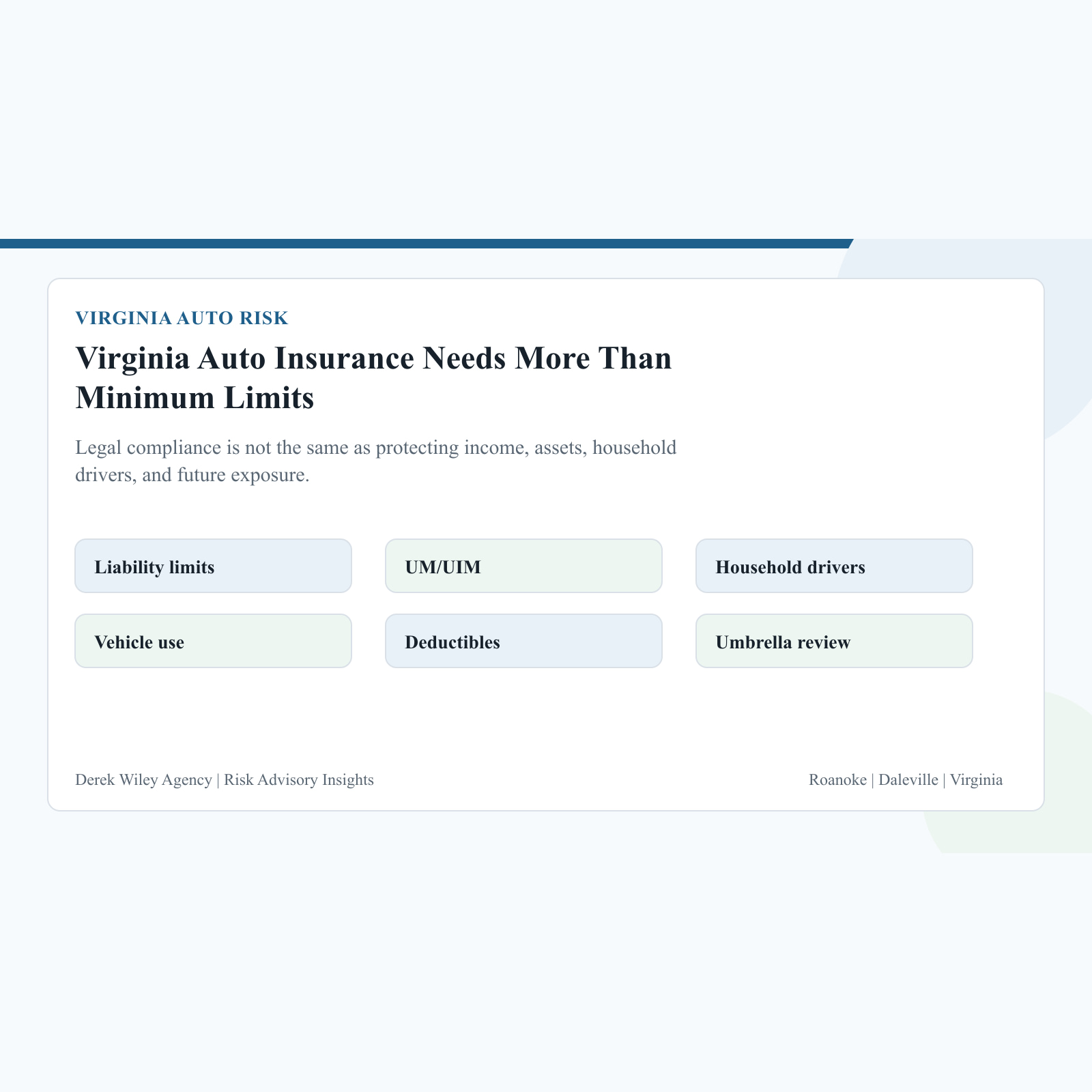
That question requires more than a minimum-limit quote. It requires a review of liability limits, uninsured and underinsured motorist coverage, household drivers, vehicle use, deductibles, assets, and whether umbrella coverage should be part of the plan.
Legal compliance is not the same as asset protection.

Minimum auto insurance exists to set a legal floor. It does not automatically mean the coverage is enough for a serious accident.
A driver can meet the requirement and still have limits that are too low for a major injury claim, multi-vehicle crash, lost wages allegation, or lawsuit. In that situation, the policy may respond up to the limit, but the client’s personal exposure may continue beyond it.
That is why DWA frames auto insurance as a liability and asset-protection conversation, not only a vehicle-repair conversation. The damage to the car may be the visible part of the accident. The injury claim, legal demand, wage loss, medical costs, and underinsured driver issues may be the part that creates lasting financial risk.
That is the same advisory gap explained in why an insurance quote is not a risk strategy: the number on the proposal matters, but it does not explain whether the limits fit the exposure.
Virginia auto coverage has state-specific details.
Derek often points out that auto insurance is not identical from state to state. A driver moving from Florida, North Carolina, New York, or another state may expect certain coverages or rules that do not apply the same way in Virginia.
One example from Derek’s transcript is household and resident-relative exposure. In Virginia, the way household members and resident relatives are treated can create underwriting and coverage issues that should not be ignored. If a spouse, child, sibling, cousin, or other resident relative is part of the household, the insurance company may need to know. Trying to avoid that conversation can create problems later.
This is where a local advisory process matters. A call center or generic quote flow may gather basic driver and vehicle data. A risk advisor should ask how the household is actually structured and who may create exposure under the policy.
“Full coverage” is not a technical strategy.
Many drivers use the phrase “full coverage” to mean they have more than liability-only insurance. Usually, they mean the policy includes comprehensive and collision coverage for the vehicle.
That phrase can be misleading. A policy may include comprehensive and collision while still carrying low liability limits. It may not include the rental reimbursement someone expects. It may handle business use differently than the driver assumes. It may have deductibles or exclusions the client has never reviewed. It may also fail to coordinate with umbrella coverage.
In other words, “full coverage” does not answer the most important questions. It does not tell you whether the liability limits are adequate, whether uninsured/underinsured motorist coverage is appropriate, whether drivers are listed correctly, or whether the policy fits how the vehicle is used.
Uninsured and underinsured motorist coverage deserves attention.
Virginia’s insurance requirement changes made headlines, but uninsured and underinsured motorist exposure still deserves a real review. Even when more drivers are required to carry insurance, not every driver carries enough insurance.
If someone causes an accident and does not have enough coverage for the damage or injury they cause, the injured person’s own policy may become important. That is why DWA does not treat uninsured/underinsured motorist coverage as a minor detail. It can be one of the most important parts of the auto policy when the other driver’s coverage is not enough.
For families in Roanoke, Daleville, Botetourt County, and across Virginia, this is especially important when the household depends on income, savings, transportation, or future earning ability.
Household drivers should not be handled casually.

Auto coverage should be reviewed when there are teen drivers, college students, aging parents, spouses with different driving histories, household members with prior accidents, or vehicles used by multiple people.
Those details affect more than price. They can affect underwriting, eligibility, claim handling, and whether the carrier believes it had accurate information when the policy was written.
DWA’s position is straightforward: be honest, review the household accurately, and structure the policy around reality. Trying to hide a driver or avoid a difficult underwriting conversation may create a larger problem later.
Auto and umbrella coverage often belong in the same conversation.
A serious accident can expose more than the vehicle. It can expose home equity, savings, retirement assets, income, future earnings, and business-owner assets. That is why auto insurance and personal umbrella insurance often need to be reviewed together.
An umbrella policy is not a substitute for proper auto coverage. It usually sits above qualifying underlying liability limits. That means the auto policy still has to be structured correctly. But for households with assets or income to protect, the umbrella conversation may be one of the most important parts of the review.
When an accident could reach beyond the auto policy, the next question is whether umbrella insurance should sit above the auto limits to protect household assets and future income.
What to do next.
If your auto coverage was selected because it met the minimum requirement, matched an old policy, or produced the cheapest quote, it is worth reviewing.
Derek Wiley Agency helps drivers in Roanoke, Daleville, Botetourt County, and across Virginia review auto insurance through a Risk Advisory lens. That review can include liability limits, underinsured and uninsured motorists, household drivers, vehicle use, deductibles, and whether umbrella coverage should be part of the plan.
FAQs
Are Virginia minimum auto insurance limits enough?
Minimum limits may satisfy the legal requirement, but they may not be enough for a serious accident, injury claim, lawsuit, or asset-protection need. Drivers should review limits based on their real exposure.
Is auto insurance different in Virginia than in other states?
Yes. Auto insurance rules and coverage details vary by state. Drivers moving into Virginia should review how their household, drivers, and coverages are handled under Virginia rules.
What does “full coverage” mean?
“Full coverage” is informal shorthand. It often means a policy includes comprehensive and collision, but it does not automatically mean liability limits, uninsured motorist coverage, vehicle use, deductibles, or umbrella coordination are adequate.
When should auto insurance be reviewed with umbrella insurance?
Auto and umbrella coverage should be reviewed together when a household has home equity, savings, income, young drivers, business ownership, rental exposure, or other assets that could be exposed after a serious liability claim.