What Business Owners in Virginia Should Review Before Assuming They Are Covered
A business insurance policy can look complete on paper and still fail to match the way the business actually operates.
That is the central risk for many small business owners. They have a policy. They may even have general liability, commercial auto, workers compensation, property coverage, and certificates of insurance. But if no one has taken the time to understand the business itself, the coverage may be built around labels instead of reality.
Derek Wiley Agency approaches business insurance differently. The first question is not only “what kind of policy do you need?” The first question is “how does the business actually create risk?”
For Virginia business owners, contractors, service companies, trades, local employers, and professional firms, that question matters.
Start with operations, not policy names.

Business owners often ask for a general liability quote, a workers compensation quote, or a commercial auto quote. Those are useful categories, but they are not enough by themselves.
A proper review should ask how the business operates:
- What services do you perform?
- Where is the work performed?
- Do employees, subcontractors, or owners drive for business?
- Do you use personal vehicles for business activity?
- Do contracts require certain limits, endorsements, or additional insured wording?
- Do customers, vendors, or workers come onto your premises?
- Do you own tools, equipment, inventory, buildings, or leased property?
- What would stop revenue if something went wrong?
Those answers shape the coverage. Without them, the policy may be little more than a form with a business name attached.
General liability does not cover every business problem.
General liability is important, but it is also commonly misunderstood. Business owners may assume it covers anything connected to the business. It does not.
Depending on the situation, a claim may involve professional liability, errors and omissions, workers compensation, commercial auto, employment practices, cyber, property, inland marine, pollution, completed operations, or contract-specific requirements. Workmanship problems and faulty work allegations can be especially complicated.
That is why DWA does not treat general liability as a blanket answer. The agency reviews the business activity first, then helps determine which policy types and endorsements should be discussed.
Commercial auto can be missed when vehicles feel personal.
Many business owners use vehicles in ways that blur the line between personal and business use. A personal vehicle may be used to visit job sites, meet clients, carry tools, make deliveries, or move between properties.
That matters because personal auto policies may handle business use differently than the owner expects. If the vehicle is part of how the business operates, it should be reviewed. The answer may not always be a separate commercial auto policy, but the question should not be ignored.
This is especially relevant for contractors, consultants, salespeople, landscapers, real estate-related businesses, service companies, and local trades.
Workers compensation is more than a compliance checkbox.
Workers compensation is often discussed as a legal requirement. That is part of it, but not the whole issue.
Employee injuries can affect the worker, the business, the owner, customer relationships, contracts, payroll, and operations. If a business owner uses subcontractors, casual labor, family help, or seasonal workers, the review becomes even more important.
Derek’s workers compensation guidance makes a broader point: the client needs someone who can help them think through the situation, not just someone who sold a policy and disappeared. A business owner should know who to call when a claim or coverage question becomes complicated.
Certificates, contracts, and additional insured requests can change the risk picture.
Many businesses are asked to provide certificates of insurance. Some are asked to list another party as an additional insured. Others sign contracts with insurance requirements they may not fully understand.
Those requests should not be handled casually. A certificate can prove coverage exists, but it does not rewrite the policy. Additional insured wording, waiver of subrogation, primary and noncontributory language, completed operations requirements, and contract limits can all affect the review.
For a business owner, the issue is not just “can I get the certificate?” It is “does my coverage actually support the promise I am making?”
Claims advocacy matters when the business cannot afford confusion.
When a business has a claim, delay and confusion can create real costs. A vehicle may be down. A job may be paused. An employee may be injured. A customer may be unhappy. A contract may be at risk. A property loss may interrupt revenue.
DWA’s independent agency role matters here. Derek has explained that an independent agent is not the carrier. The customer is the client. The agency can help the business understand the process, communicate with the carrier, and think through practical next steps.
That does not mean every claim will be easy or every disputed issue will be resolved in the client’s favor. It does mean the business owner is not trying to interpret the process alone.
The same principle applies on the personal side too. A business owner who protects revenue and contracts should also understand the difference between quoting coverage and building a risk strategy.
Business insurance and personal risk can overlap.
Business owners often have personal assets connected to business success: home equity, savings, income, personal guarantees, vehicles, or property. The business policy and personal policies are not the same, but the risk conversation should recognize both sides.
That is why a business owner may need to review business insurance, commercial auto, workers compensation, general liability, commercial umbrella, personal umbrella, and personal asset protection as related pieces of a broader plan.
What DWA reviews with Virginia business owners.
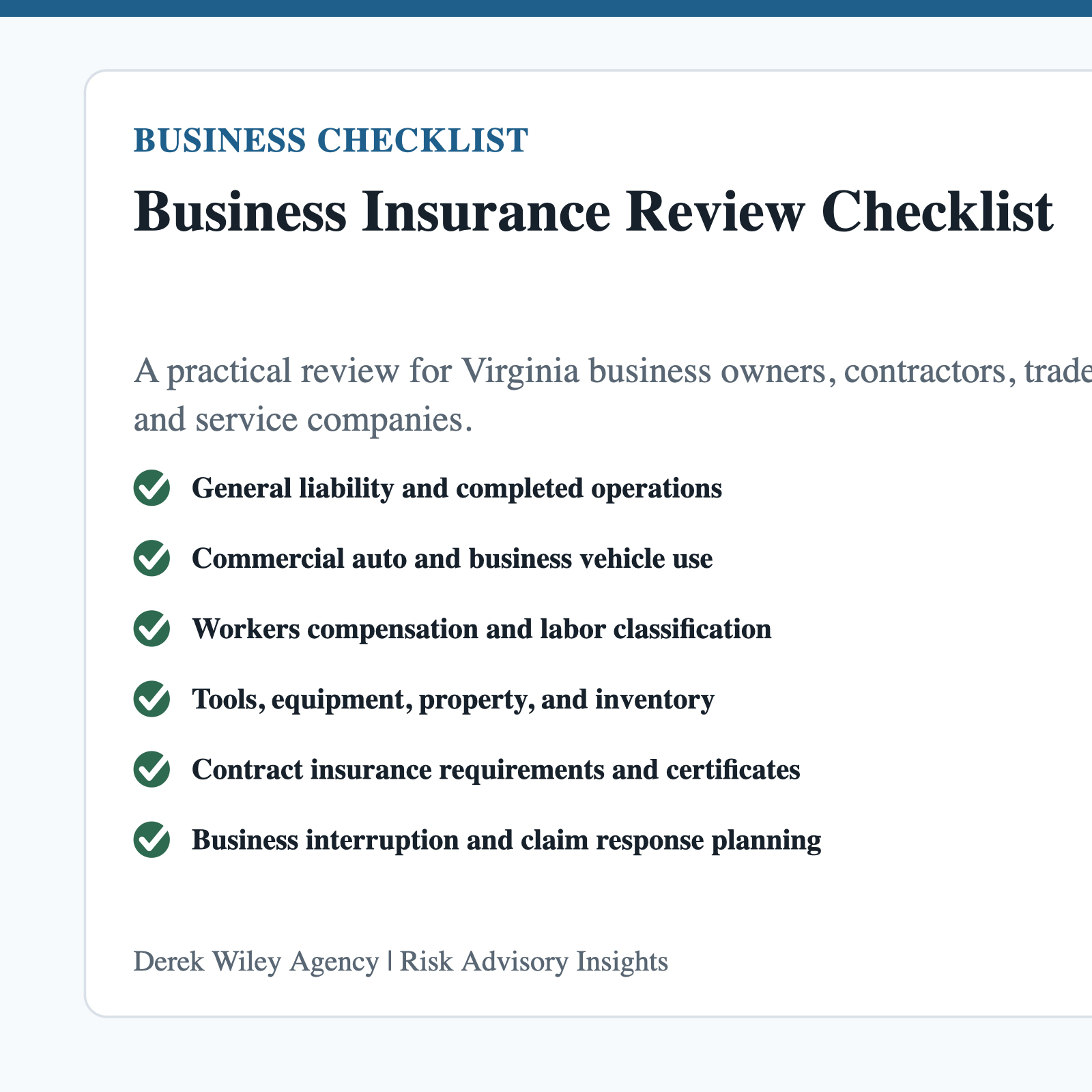
A DWA business insurance review may include:
- Business operations and service types
- General liability and completed operations exposure
- Commercial auto and hired/non-owned auto exposure
- Workers compensation and employee classification issues
- Property, tools, equipment, inventory, and inland marine needs
- Contract insurance requirements and certificate requests
- Business interruption and revenue exposure
- Owner assets and umbrella considerations
- Claims process and service expectations
The goal is not to make insurance more complicated. The goal is to prevent a simple-looking policy from failing because nobody asked how the business really works.
For owners whose personal assets, vehicles, home equity, or income are tied closely to the business, it may also be worth reviewing umbrella protection as part of the broader liability plan.
What to do next.
If your business insurance was selected quickly, copied from an old policy, or built around a generic class of business, it is worth reviewing.
Derek Wiley Agency helps Virginia business owners review business insurance through an operations-first Risk Advisory lens. Related coverage may include general liability insurance, commercial auto insurance, workers compensation insurance, commercial umbrella, and personal asset-protection planning where appropriate.
FAQs
What should a Virginia business owner review in a business insurance policy?
Business owners should review operations, liability exposure, vehicles, employees, subcontractors, contracts, certificates, property, tools, equipment, revenue interruption, and claims support.
Does general liability cover every business problem?
No. General liability is important, but it does not cover every type of business risk. Depending on the situation, professional liability, workers compensation, commercial auto, property, cyber, employment practices, or other coverage may be needed.
When does a business need commercial auto insurance?
Commercial auto should be reviewed when vehicles are owned by the business, used regularly for business activity, used to transport tools or products, driven by employees, or otherwise connected to business operations.
Why does workers compensation matter for small businesses?
Workers compensation can affect compliance, employee injury claims, contracts, payroll, and business continuity. It should be reviewed based on how the business actually uses employees, subcontractors, and labor.